2026 World Cup Triples Brazilian Bettor Numbers, Raising Concerns
 AI-GENERATED
The 2026 FIFA World Cup triggered a significant surge in gambling activity in Brazil. A survey shows the number of bettors tripled, leading to calls for tighter regulation.
The 2026 FIFA World Cup has boosted the gambling industry in Brazil, but also raised serious concerns. A recent study reveals an exponential increase in bettors across the country. The numbers are significant, highlighting the risks of unregulated markets. It shows how quickly the social fabric can change when gambling becomes ubiquitous. The impacts are diverse, ranging from personal financial problems to concerns about player and youth protection.
Football enthusiasm has always been immense in Brazil. The World Cup provides a special incentive for millions of people. However, current developments show that this passion also has its downsides. Finance Minister Dario Durigan has already announced new regulatory measures to control the situation. It will be interesting to see what steps the government will take to tame the market and protect the population.
Numbers and facts
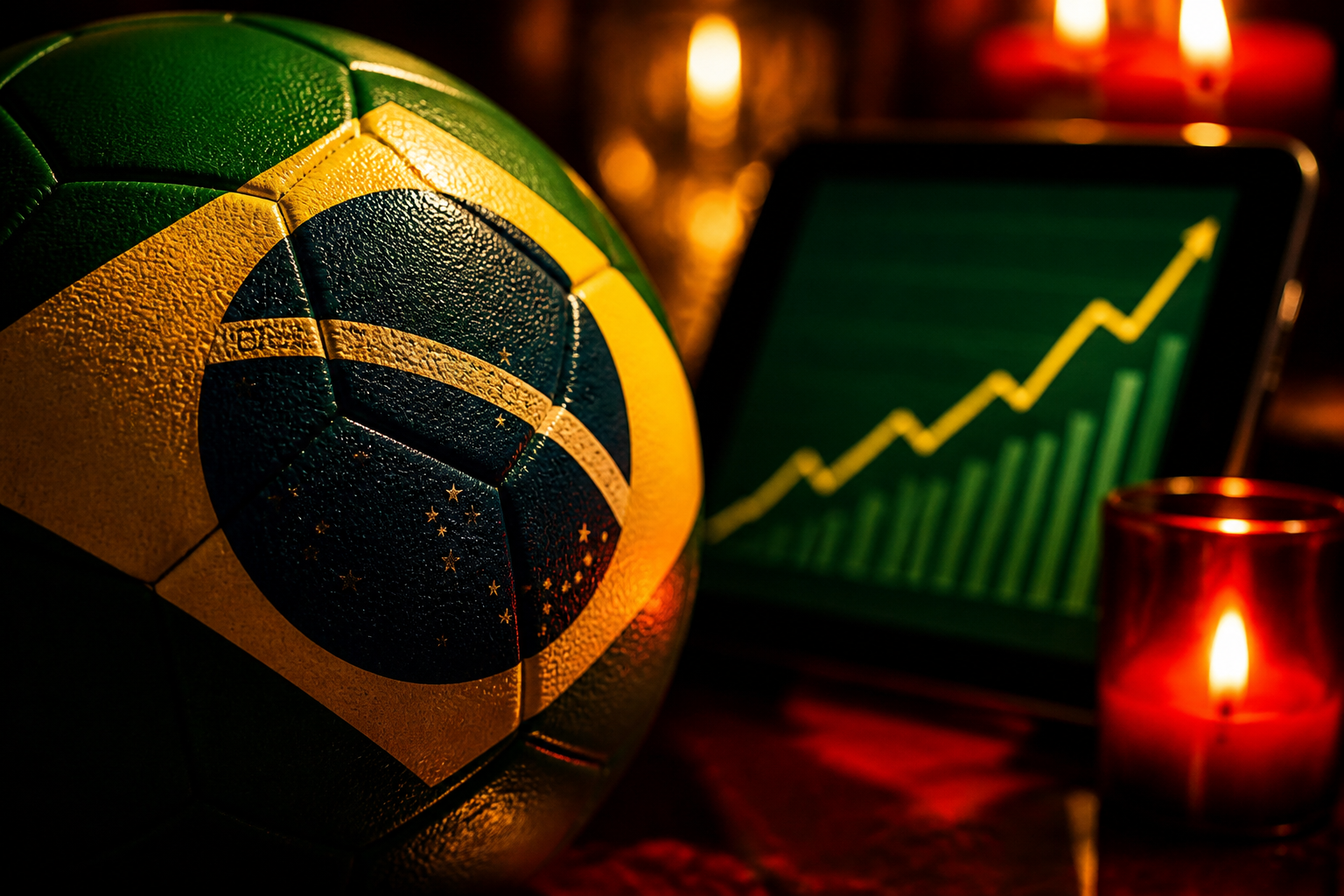
A survey conducted by the consulting firm Ipsos for the Brazilian Association of Online Gaming and Betting (ABA) concluded that the number of Brazilian gamblers tripled during the 2026 World Cup. Brazilian fintech company Klavi confirms this in its own study, based on a sample of 1.2 million people, where the percentage of Brazilians placing bets rose from 11 percent in May before the tournament kicked off to around 35 percent at the end of June. The sports betting industry has thus developed into a huge economic factor. According to a 2023 report by data analysis company Comscore, Brazil is the third-largest market for sports betting worldwide, trailing only the US and the UK.
However, this development also has alarming side effects. According to Brazil's health ministry, the number of people seeking care for gambling addiction has more than doubled in the past five years. A 2025 study by the non-profit Institute of Studies for Health Policies estimates that gambling and betting cost Brazilian society 38.8 billion reais, or about 7 billion US dollars, annually. These costs include an increase in suicides and depression linked to gambling addiction. Advertising for sports betting is particularly criticized. Television channels like CazéTV, which hold broadcast rights for all 104 games in Brazil, have not only run traditional commercials but also used commentators to promote betting during games. Carolina Terra, a professor at the University of São Paulo, highlights the dangers:
"Betting is intended for people aged 18 and over. But when it is embedded in content, anyone can be exposed to it, including children, teenagers, and other vulnerable groups. The exposure becomes indiscriminate." - Carolina Terra, Professor at the University of São Paulo
The National Consumer Secretariat, a branch of the Ministry of Justice, has launched an investigation into possible irregularities during CazéTV's World Cup broadcasts. Brazil's advertising self-regulator has also opened three proceedings regarding betting offers.
Background
Although sports betting was legalized in Brazil in 2018, a largely unregulated market coupled with aggressive advertising led to significant problems. This prompted the government to introduce new regulations in 2023. These measures are intended to curb uncontrolled growth and better protect the population. However, the debate about how comprehensive this regulation needs to be continues. The high revenues from gambling taxes conflict with the social costs of gambling addiction. Senator Eduardo Girão spoke of a "humanitarian tragedy" unfolding in Brazil during a public hearing in the Senate. This underscores the urgency of the situation and the need for quick action by the authorities.
Why it matters for German players
The situation in Brazil clearly illustrates the dangers of an inadequately regulated gambling market. For German players, the conditions are quite different, thanks to the German State Treaty on Gambling 2021 (GlüStV 2021). This treaty has created the legal basis for online gambling in Germany and introduced strict rules that prioritize player protection. All legal providers in Germany must hold a license from the Joint Gambling Authority of the Federal States (GGL) and are listed on the GGL's so-called whitelist. This ensures that providers adhere to legal requirements.
Key protective measures include a deposit limit of 1,000 euros per month, which is monitored across all players via the central LUGAS system, and a stake limit of 1 euro per spin for online slot machines. There are also strict rules for advertising and the so-called panic button, which allows players to self-exclude immediately. These measures are designed to prevent players from falling into addiction or overextending themselves financially. While regulation in Brazil is still largely under construction and player despair is increasing, German players can rely on a comparatively safe and transparent environment, provided they play with licensed providers.
What it means for GGL-licensed casinos
For online casinos holding a German GGL license, the experiences from Brazil confirm that comprehensive player protection is essential. Player trust in regulated offerings increases when they know they are protected from excessive advertising and easily accessible gambling options. GGL-licensed casinos must comply with strict German requirements, which promotes responsible gambling behavior.
This includes not only the aforementioned limits but also detailed reporting obligations and ensuring data integrity. German regulatory authorities regularly review compliance with these requirements. This makes the black market less attractive and directs players to legal providers who offer safety and fair gaming conditions. GGL-licensed casinos are thus pioneers in player protection and transparency, which will have a long-term positive impact on the entire industry.
Frequently asked questions
How did the number of players in Brazil change during the 2026 World Cup?
The number of Brazilian players tripled during the 2026 FIFA World Cup. A survey by Ipsos on behalf of ABA shows this significant increase. A study by Klavi confirms this, with a rise from 11 to 35 percent.
What are the negative consequences of the increase in gambling activities in Brazil?
The number of people seeking help for gambling addiction has more than doubled in the last five years. Furthermore, a study estimates that gambling and betting cost Brazilian society approximately 7 billion US dollars annually, including costs for suicides and depression.
How is advertising for sports betting in Brazil criticized?
The integration of sports betting into content that can reach children and adolescents is criticized. TV channels like CazéTV advertised bets not only with spots but also through commentators during matches.
What steps is the Brazilian government taking regarding the gambling market?
The Minister of Finance announced new regulatory measures to control the situation. The National Consumer Secretariat is investigating potential irregularities in World Cup broadcasts, and the advertising self-regulatory body has opened proceedings on betting offers.
What player protection measures exist in Germany compared to Brazil?
German players are protected by the State Treaty on Gambling 2021 (GlüStV 2021) with strict rules. These include a deposit limit of 1,000 euros per month and a bet limit of 1 euro per spin on online slot machines, which is not currently present in Brazil to the same extent.
What do the Brazilian experiences mean for GGL-licensed casinos in Germany?
The experiences from Brazil underscore the necessity of comprehensive player protection, as offered by GGL casinos through adherence to German regulations. This strengthens player trust in regulated offerings and makes the black market less attractive.
Share
About the author

Lisa Lustich
Editor-in-chief & casino tester
Lisa Lustich has been testing German-language online casinos since 1997 and runs the Lustich.de newsroom. More than 400 published reviews, certified player-protection advisor (BZgA training, 2019).
All articles by Lisa Lustich →Sources & further reading
Whitelist of permitted online operators
Editorial guidelines Lustich.de
BZgA problem-gambling helpline: 0800 1 372 700
 Brazil
Gambling can be addictive. Please play responsibly. Help and counselling at 0800 1 372 700 (BZgA, free & anonymous).
Read this article in 57 languages
- German
- English
- Portuguese
- French
- Italian
- Spanish
- Japanese
- Polish
- Arabic
- Dutch
- Russian
- Turkish
- Swedish
- Danish
- Norwegian
- Finnish
- Korean
- Hindi
- Indonesian
- Thai
- Vietnamese
- Chinese
- Czech
- Hungarian
- Romanian
- Greek
- Ukrainian
- Croatian
- Bulgarian
- Filipino
- Slovak
- Serbian
- Hebrew
- Persian
- Malay
- Bangla
- Tamil
- Telugu
- Urdu
- Georgian
- Khmer
- Albanian
- Kazakh
- Afrikaans
- Lithuanian
- Latvian
- Estonian
- Slovenian
- Uzbek
- Swahili
- Azerbaijani
- Amharic
- Tajik
- Kyrgyz
- Sinhala
- Hausa
- Nepali
Related topics
Further Reading
 AI-GENERATED
Hub88 Integrates Showtime Slots: Gametimetec Expands Portfolio in 2026
Aggregator Hub88 significantly expands its offering by integrating Gametimetec's Showtime Slots, bringing its network to over 12,000 available games.
 AI-GENERATED
Cantor Fitzgerald Launches Block Trading for Prediction Markets
Investment bank Cantor Fitzgerald introduces institutional block trading for event contracts on regulated markets, providing large-scale access for professional investors on Kalshi.
 AI-GENERATED
Happy Valley Casino struggles: Financial slump for new Pennsylvania mini-casino
Happy Valley Casino reported a disappointing $2.5 million in July revenue, trailing behind competitors despite hosting major local events and operating more gaming stations.