East Africa's iGaming Boom: Why the Kiosk is More Important Than the App
 AI-GENERATED
Despite the digital shift, physical retail remains the backbone of the African market. In Kenya alone, the number of mobile money agents rose to 602,470 by June 2026.
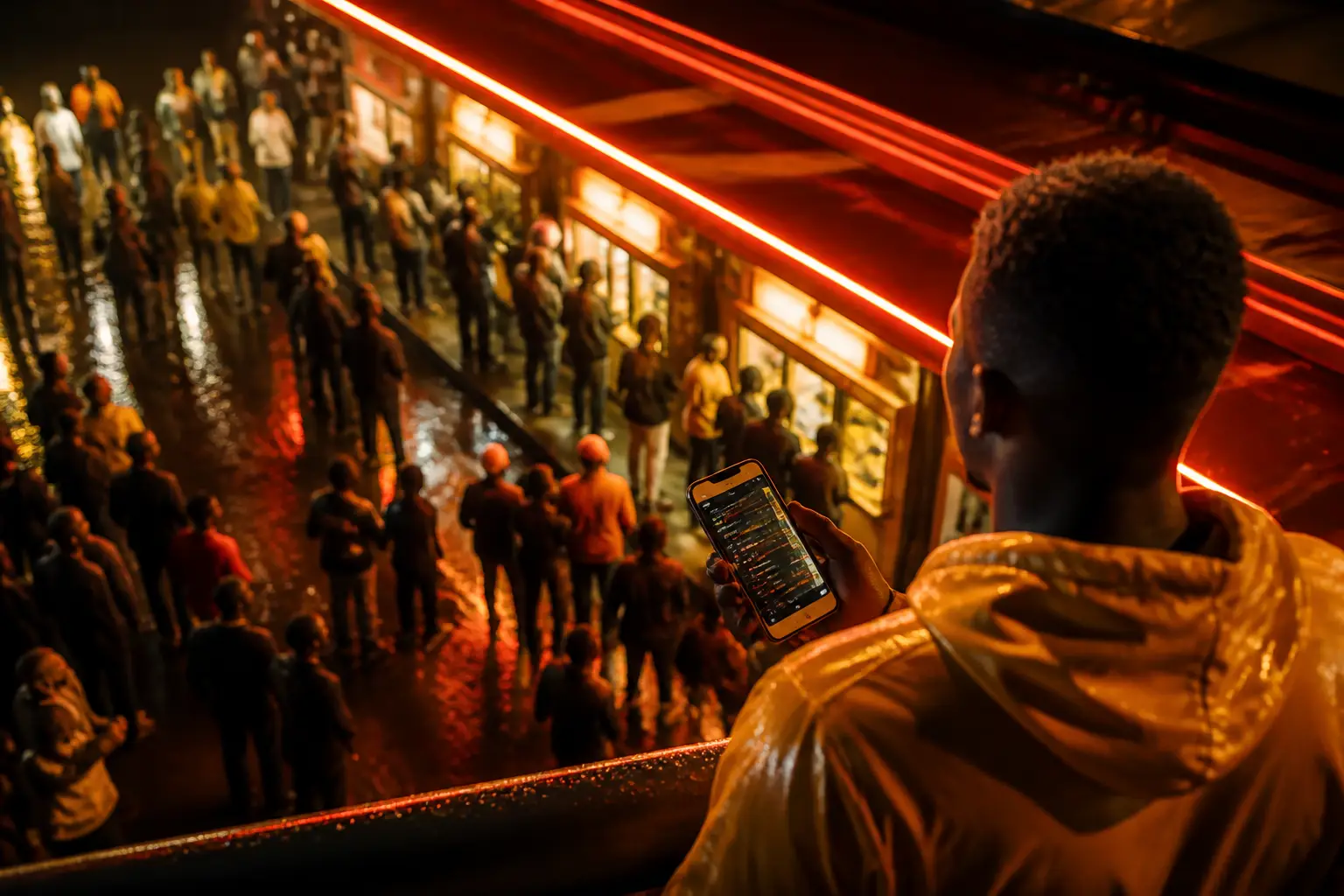
Anyone thinking of betting in East Africa usually has a smartphone in mind. A tap in the app, payment via M-Pesa, and done. But the reality on the streets of Nairobi, Kampala, or Dar es Salaam looks different. Hidden behind the digital facades is a massive network of kiosks, small shops, and agents. These physical locations are the true heart of the industry. Without the agent who takes the customer's cash and converts it into digital credit, the system would simply grind to a halt in many regions. The mobile shift is thus more of an interface, while retail provides the necessary infrastructure.
In Kenya, this dependency can be proven with impressive figures. By June 2026, the country's central bank counted 602,470 registered mobile money agents. This is an increase of over 100,000 agents in just a single quarter. These people stand on corners, in so-called dukas, where they handle deposits for betting accounts alongside cooking oil and airtime. It is a hybrid model that blurs the lines between online and offline. For operators, this means that not only programmers are in demand, but above all, people who can build networks on the ground.
Numbers and facts
The economic dimension of this sector is enormous. M-Pesa, the leading provider of mobile money, processed transactions worth KSh 41.68 trillion in the financial year to March 2026, which corresponds to approximately 322 billion US dollars. This is an increase of 25 percent compared to the previous year. Tax authorities have also recognized this. Kenya's Finance Act 2025 shifted excise duty from the point of the wager to the point of deposit. While the headline rate fell from 15 to five percent, the parliament expects revenue to double from KSh 5.4 billion to KSh 11.4 billion due to the broader base.
In Uganda, a similar picture emerges. Denis Mudene Ngabirano of the National Lotteries and Gaming Regulatory Board emphasizes that almost 99 percent of gaming activity runs through mobile money. But even he knows that this money usually starts as physical shillings at a kiosk. Authorities are now using this trail for stricter monitoring. Uganda now relies on a flat tax of 30 percent on gaming revenue to control the market and deter illegal providers.
"You cannot take a one-size-fits-all approach to building a successful betting brand in Africa. You have to understand each market, and you have to earn your place in it." - Jason Gibson, Chief Commercial Officer at SportPesa
Background
Expansion into markets like Tanzania or Zambia requires forensic precision. Since censuses often take place only every ten years and informal incomes are difficult to capture, experts like Ben Longman from Trendtype use satellite imagery to analyze commercial flows. It has been shown that betting shops do not necessarily flourish where the wealthiest people live, but where there is the highest density of daily errands. In Nairobi, the most active zones are concentrated in the east and the center, along major transport routes, and less in the wealthy northern suburbs like Westlands.
Another problem remains regulation. In many of the 54 African states, laws exist only on paper. In the DR Congo, for example, providers generate an estimated 1.7 billion US dollars in revenue, while the state sees only one million dollars in taxes. South Africa remains the shining exception and the historical role model. With a betting volume of 1.5 trillion ZAR (approx. 89 billion US dollars) in the 2024/2025 financial year, the country shows what a functioning, state-monitored market can look like.
Why it matters for German players
For German players, the focus on kiosks and cash may seem outdated, but the regulatory logic behind it is not that far off. In Germany, the State Treaty on Gambling 2021 (GlüStV 2021) ensures equally strict monitoring of money flows, albeit purely digitally. While in Kenya the deposit at the kiosk is the control point, in this country, it happens via the LUGAS system and the limit control file. Anyone playing at a GGL-licensed provider is bound by the monthly deposit limit of 1,000 euros, regardless of how many casinos they have an account with.
In addition, the stake limits of one euro per spin for online slots are a German peculiarity designed to strengthen player protection. The African market shows that transparency in payments is the key to acceptance. German customers should make sure to play exclusively at providers on the GGL whitelist. MGA or Curacao licenses offer no protection by German authorities and often violate local laws. The security offered by a licensed German provider is comparable to the goal of African regulators: to dry up the black market and ensure player protection through clear rules.
What it means for GGL-licensed casinos
German operators can learn from the development in East Africa that the interlocking of payment methods and state supervision is the future. While Africa relies on agent networks, German casinos must perfect their identification procedures (KYC) and the connection to LUGAS. The GGL strictly monitors whether deposits and stakes comply with the legal framework. An operator that fails here quickly loses its license. Transparency in the value chain, as Trendtype maps it for Africa, is already a reality in Germany through digital monitoring.
Frequently asked questions
Why is retail so important for African iGaming?
Many players in East Africa own smartphones but use cash to top up their digital wallets. Agents in kiosks act as a physical interface for deposits and withdrawals, making them the backbone of the industry.
How many mobile money agents are there in Kenya?
According to data from the Kenyan Central Bank, there were exactly 602,470 registered agents by June 2026. Over 100,000 new locations were added in the second quarter of 2026 alone.
What new taxes apply in East Africa?
Kenya has shifted excise duty to the point of deposit, while Uganda imposes a flat tax of 30 percent on gaming revenue. Tanzania has introduced a five percent excise tax on stakes.
How large is the gambling market in South Africa?
South Africa is the continent's leading market with a betting volume of 1.5 trillion ZAR (approx. 89 billion US dollars) in the 2024/2025 financial year. The country is considered a pioneer for modern gambling regulation in Africa.
What do these global trends mean for players in Germany?
Globally, there is a trend toward stricter monitoring of money flows. In Germany, this is implemented through the GlüStV 2021 with the 1,000 euro deposit limit and the LUGAS system, which is only guaranteed at GGL-licensed casinos.
Share
About the author

Lisa Lustich
Editor-in-chief & casino tester
Lisa Lustich has been testing German-language online casinos since 1997 and runs the Lustich.de newsroom. More than 400 published reviews, certified player-protection advisor (BZgA training, 2019).
All articles by Lisa Lustich →Sources & further reading
Whitelist of permitted online operators
Editorial guidelines Lustich.de
BZgA problem-gambling helpline: 0800 1 372 700
 Kenya
KenyaGambling can be addictive. Please play responsibly. Help and counselling at 0800 1 372 700 (BZgA, free & anonymous).
Read this article in 57 languages
- German
- English
- Portuguese
- French
- Italian
- Spanish
- Japanese
- Polish
- Arabic
- Dutch
- Russian
- Turkish
- Swedish
- Danish
- Norwegian
- Finnish
- Korean
- Hindi
- Indonesian
- Thai
- Vietnamese
- Chinese
- Czech
- Hungarian
- Romanian
- Greek
- Ukrainian
- Croatian
- Bulgarian
- Filipino
- Slovak
- Serbian
- Hebrew
- Persian
- Malay
- Bangla
- Tamil
- Telugu
- Urdu
- Georgian
- Khmer
- Albanian
- Kazakh
- Afrikaans
- Lithuanian
- Latvian
- Estonian
- Slovenian
- Uzbek
- Swahili
- Azerbaijani
- Amharic
- Tajik
- Kyrgyz
- Sinhala
- Hausa
- Nepali
Related topics
Further Reading
 AI-GENERATED
Evoplay Strengthens Bulgarian Footprint with Major efbet Integration
Game developer Evoplay has launched 20 slot titles with Bulgarian operator efbet, focusing on popular Bonus Buy mechanics in the regulated market.
 AI-GENERATED
Hard Rock Bet Sportsbook Debuts Star-Studded After Dark Campaign
Hard Rock Bet has launched its After Dark marketing blitz featuring Fat Joe and Michael Irvin. The campaign includes a $100 bonus bet offer for new users.
 AI-GENERATED
Piracy as a Driver: How Illegal Streaming Fuels the Gambling Black Market
A study by Gaming Compliance International reveals that 95% of investigated illegal sports streams during the World Cup carried ads for unregulated gambling.