
Blackjack Card Counting: Why It Works Offline — And Is Practically Impossible Online
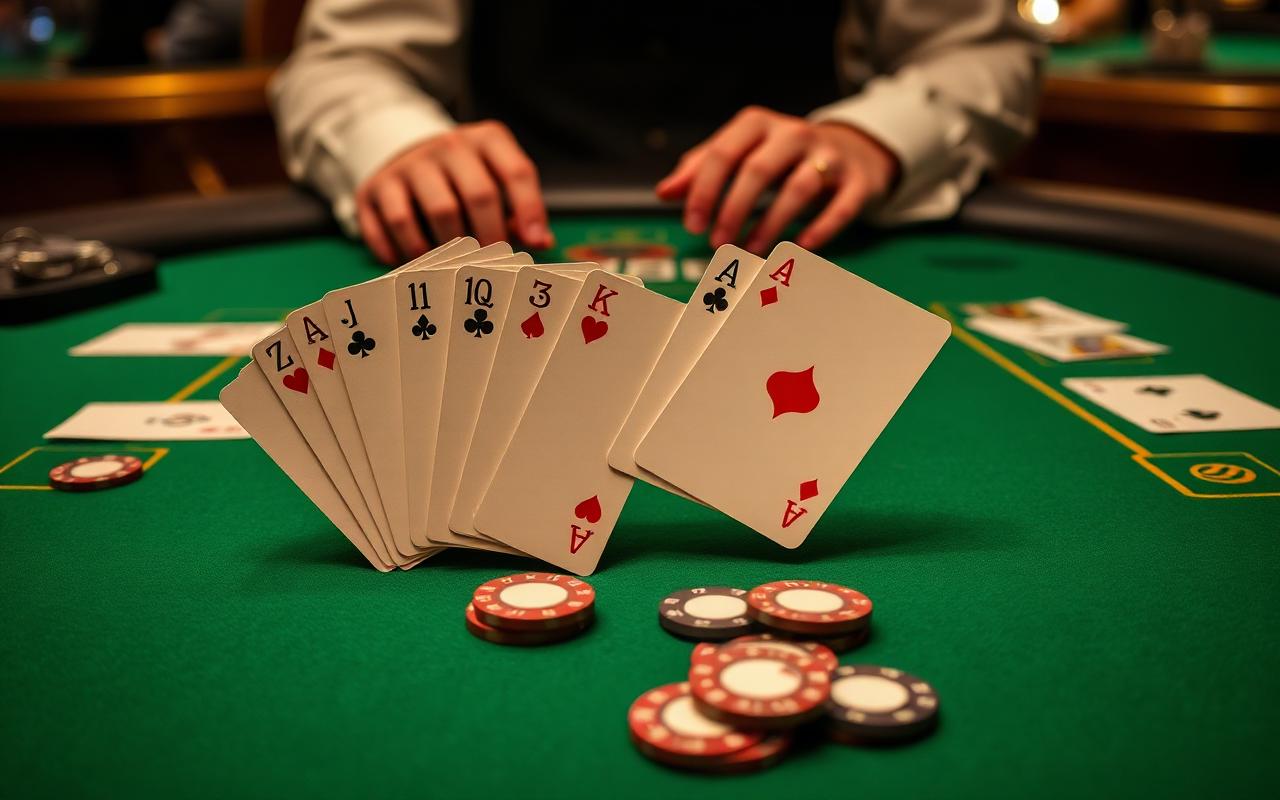
Few casino disciplines are wrapped in as much mythology as blackjack card counting. Hollywood films like '21' (2008) and bestsellers like Edward Thorp's 'Beat the Dealer' (1962) cemented the image of the math-prodigy student who beats the house with mental arithmetic alone. Card counting is in fact mathematically sound and legal — but in practice only workable under very specific conditions. In this guide we explain how professional counters in Las Vegas or Baden-Baden can flip a built-in house edge of around 0.5% into a player edge of up to +1% — and why the exact same techniques deliver nothing in the online blackjack tables of German GGL casinos.
The underlying idea is astonishingly simple. A classic blackjack deck holds 52 cards. High cards (10, Jack, Queen, King, Ace) favour the player because they increase the chance of blackjacks (paying 3:2) and force the dealer to bust more often. Low cards (2, 3, 4, 5, 6) favour the casino. By keeping a running tally of which cards have left the shoe, a player always knows whether the remaining mix is high- or low-heavy — and can vary stakes accordingly: small bets when the dealer is ahead, large bets when the player is ahead. That's the entire principle in one sentence.
The simplest and most widely used system is Hi-Lo, developed by Harvey Dubner in 1963. Cards 2–6 count as +1, cards 7–9 as 0, cards 10 through Ace as -1. Start at zero and add or subtract with every visible card. A high positive total means: good for the player. A high negative total: good for the house. With a six-deck shoe, the 'running count' must be divided by the remaining decks to derive the 'true count'. Once the true count is +2 or higher, it's time to raise bets. A seasoned Hi-Lo counter achieves a 0.5%–1.0% edge at well-chosen casinos — modest, but profitable in the long run given enough volume.
Advanced systems like KO (Knock-Out), Omega II, or Wong Halves work with finer weightings and skip the true-count conversion. They are theoretically more accurate but cognitively brutal — even trained counters make significant errors over multi-hour sessions. That's why most professional blackjack teams (such as the famous MIT Blackjack Team of the 1990s) preferred Hi-Lo, combined with 'spotters' who only count and 'big players' who only place the large bets — a division of labour that minimises detection risk.
And that's exactly where the fundamental problem for online play begins. In classic live casinos (Baden-Baden, Hohensyburg, Wiesbaden, Las Vegas) cards are drawn from a 6- or 8-deck shoe that is only dealt down to one-half or two-thirds before being shuffled. That depth gives the counter enough visibility to make meaningful inferences. In online blackjack at German GGL casinos (JackpotPiraten Casino, bwin Casino, Tipico Games) the principle collapses: the random number generator (RNG) virtually shuffles a complete fresh deck after every single hand. Every count resets after every hand — the statistical distribution of the next card is always the mathematically perfect 1/52 probability. Card counting is mathematically pointless here.
Live-dealer blackjack with real cards and real dealers would in theory be the exception — but live casino is strictly forbidden in Germany under the 2021 Interstate Treaty on Gambling. GGL-licensed operators may only offer virtual slot machines, online poker, and online sports betting. Live blackjack is available only at the brick-and-mortar state casinos (Baden-Baden, Wiesbaden, Hohensyburg, Berlin). Any 'live blackjack casino' you find on the open web is being run by an illegal operator licensed in Malta, Curaçao, or the legacy Schleswig-Holstein regime — we strongly advise against them for legal and security reasons.
Even German land-based casinos make counting steadily harder. First, many houses now use continuous shuffling machines that reshuffle after every hand — classical counting becomes impossible. Second, modern pit-boss software automatically analyses bet patterns; conspicuous stake escalations quickly trigger a house ban. Third, blackjack payouts have often been reduced from 3:2 to 6:5, which inflates the house edge so much that counting is barely profitable even when executed cleanly. To count seriously today you have to systematically hunt for casinos still offering 3:2 payouts, manual shuffles, and deep deck penetration — internationally only a handful of European casinos still qualify.
What does all this mean for German online players? Anyone choosing blackjack as their main game should be realistic: in GGL online blackjack the house edge under optimal basic strategy sits between 0.4% and 0.8%, depending on the operator. That's still markedly better than slots (typically 4–7%) or roulette (2.7%). Anyone who knows the basic strategy by heart — knowing exactly when to hit, stand, double, or split — pushes losses down to the mathematical minimum. Optimal basic strategy tables are freely available (Wikipedia: 'Blackjack Basic Strategy') and belong studied before every session. Without correct basic strategy the house edge can easily balloon to 2–3% — a multiplication of losses.
Our clear verdict: card counting does not work in online blackjack at German GGL casinos — full stop. Anyone spending hours memorising Hi-Lo tables for that purpose is wasting their time. The only meaningful optimisation in online blackjack is mastering basic strategy and disciplined bankroll management. If you want the genuine card-counting experience, visit one of Germany's state casinos — Baden-Baden, with its classic six-deck shoe and 3:2 payout, remains one of the last few addresses where the old craft still works. Online, however: basic strategy, bankroll, fun. Mathematically, that's all that's on offer.
Related topics
More guides
- What Are Wagering Requirements on Casino Bonuses – and Why Are They So Important?
- Recognizing a GGL License: How to Check in 30 Seconds if a Casino is Legal in Germany
- Fast Payouts in German Online Casinos: PayPal vs. Trustly vs. Bank Transfer
- Roulette Strategies: A Reality Check — What Works and What Just Drains Your Bankroll
Latest news
- UK Gambling Commission delays deadline for new industry rules — operators get breathing space
- Accel Entertainment acquires truck-stop casino operator in Louisiana
- Casino Graz presents the Pokermania Big 50K — Austria's biggest summer 2026 poker series
- Colombia strikes down 19% gambling tax — Major win for licensed casino operators